
The Science of Reading: How Books Transform Your Brain
When you open a book, you’re not just reading you’re rewiring your brain. Every paragraph you process, every story you imagine, every new idea you encounter all these experiences physically change the way your brain works. Modern neuroscience now confirms what book lovers have always known: reading transforms us. It sharpens our thinking, strengthens our memory, deepens our empathy, and even improves our emotional well-being. Let’s explore how science explains the incredible power of reading and why every page you turn is a mental workout for a better you.

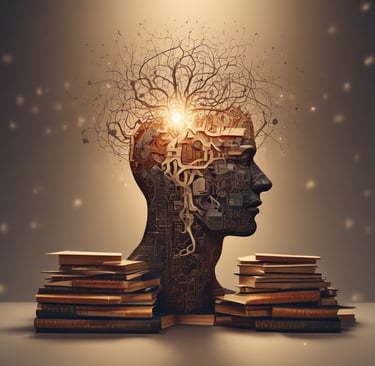
1. Reading Activates Multiple Parts of the Brain
When you read, your brain lights up like a network of highways. It’s not a single area working it’s a complex system of neural connections.
Researchers at Emory University found that reading fiction activates the left temporal cortex (responsible for language processing) and the central sulcus, which controls sensory experiences. That’s why when you read about walking through a forest, you can almost feel the crunch of leaves under your feet.
In other words, reading doesn’t just stimulate the imagination it tricks the brain into experiencing reality.
This is why avid readers often have stronger memory, focus, and imagination than non-readers. Their brains are constantly exercising decoding words, forming visuals, and feeling emotions, all at once.
2. Reading Strengthens Memory and Focus
Every time you pick up a book, you’re training your brain to remember characters, plots, facts, or lessons.
Just like physical workouts strengthen muscles, reading strengthens your working memory. Your brain learns to store and recall details, improving your ability to concentrate and retain information over time.
Neuroscientists call this “neural plasticity” your brain’s ability to reorganize and build new connections. Reading regularly keeps these pathways active, preventing cognitive decline and even reducing the risk of age-related diseases like Alzheimer’s.
So yes, books aren’t just good for your soul they’re literally a brain fitness program.
3. Reading Improves Empathy and Emotional Intelligence
Have you ever cried over a character’s loss or felt inspired by a hero’s triumph? That’s not just emotion it’s empathy training.
Reading fiction in particular engages the brain’s default mode network, responsible for understanding others’ emotions and intentions. Psychologists call this the “theory of mind” the ability to put yourself in someone else’s shoes.
Studies show that people who read literary fiction score higher in empathy tests and have stronger social awareness.
Why? Because reading constantly exposes you to different lives, cultures, and perspectives expanding your ability to relate to others in real life.
Every story you read quietly builds emotional intelligence helping you navigate conversations, relationships, and conflicts more gracefully.
4. Reading Boosts Creativity and Imagination
When you read, your brain doesn’t passively absorb words it creates worlds.
The absence of visuals in books forces your mind to visualize scenes, characters, and emotions, activating the visual cortex and prefrontal areas responsible for imagination and problem-solving.
This creative stimulation enhances your ability to think beyond limits. That’s why many inventors, writers, and entrepreneurs are voracious readers they train their minds to envision possibilities others can’t see.
Even reading fantasy or fiction indirectly boosts creativity in real-life problem-solving by strengthening your brain’s ability to connect unrelated ideas.
5. Reading Expands Vocabulary and Cognitive Power
Every book you read introduces you to new words, expressions, and sentence structures. This exposure naturally improves your vocabulary, comprehension, and articulation.
The richer your language, the more precisely you can think and express yourself.
Children who grow up reading regularly show higher IQs and stronger verbal reasoning skills as adults. Even for grown-ups, continuous reading improves mental agility keeping your brain sharp and flexible.
And for digital readers, e-books make vocabulary expansion even easier with built-in dictionaries and note features that reinforce learning instantly.
6. Reading Reduces Stress and Builds Mental Calm
Science proves that reading is one of the most effective forms of relaxation.
A 2009 study by the University of Sussex found that just six minutes of reading can reduce stress levels by up to 68%, lowering heart rate and easing muscle tension.
That’s because reading helps your mind shift away from anxiety and into a state of focus and flow. Unlike passive entertainment, it requires engagement which quiets mental noise and grounds you in the present moment.
So if you ever feel overwhelmed, don’t reach for your phone reach for a book. It’s a scientifically proven form of meditation.
7. Reading Physically Rewires the Brain
One of the most fascinating discoveries in neuroscience is that reading changes the structure of your brain.
A Harvard study revealed that frequent readers have more white matter in the brain the network responsible for communication between different regions. This improves processing speed, comprehension, and analytical thinking.
Regular reading also increases gray matter in the frontal lobe, the area linked to decision-making and judgment.
Over time, these structural changes translate into real-world benefits: better problem-solving, improved emotional control, and greater intellectual confidence.
8. Reading Builds Mental Endurance in a Distracted World
We live in a time of constant interruption short videos, quick posts, and endless multitasking. Reading, however, trains your brain to slow down and focus deeply.
This kind of sustained attention is becoming rare and valuable. People who read daily have a stronger ability to concentrate, process complex information, and resist distraction.
In a sense, reading is a form of digital detox for the brain strengthening your attention span in a fragmented world.
9. How E-Books Enhance the Science of Reading
With the rise of e-books, reading is no longer confined to paper. And surprisingly, science supports digital reading as an equally effective (and sometimes superior) way to engage the mind.
E-books allow you to:
Highlight and revisit key insights easily (reinforcing memory)
Read in low light without strain (using adaptive brightness)
Access more books, increasing exposure to diverse ideas
For many, e-books remove the barriers of access, making it easier to maintain reading habits and therefore, reap all the brain benefits that come with them.
Platforms like MetaverseBook.Shop make that experience seamless helping you explore topics that challenge, educate, and inspire, all in one digital library.
Final Thoughts: Your Brain on Books
Reading is not a passive act it’s one of the most powerful exercises your brain can perform.
Every time you read, you are:
Strengthening neural connections
Expanding your emotional world
Enhancing focus and creativity
Building a sharper, calmer, more resilient mind
So the next time you open a book printed or digital remember: you’re not just reading.
You’re training your brain to become its best version.
Start transforming your brain today.
Discover powerful e-books on MetaverseBook.Shop where science meets storytelling, and every word rewires your world.
Contact
Get in touch
Follow
Connect
+91 8850961942
© 2025 Metaversebooks – A division of JBSD Group.
Metabooks operates under the publishing and digital content business of JBSD Group.
© 2025. All rights reserved.